
SIP vs FD vs Gold: Where Should Indians Invest Their Money in 2026
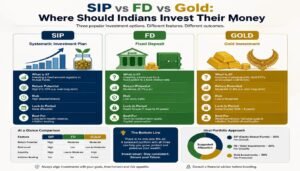
Indians have three classic choices when they want to grow their savings: Systematic Investment Plans (SIPs) in mutual funds, Fixed Deposits (FDs), and Gold. Each serves a different purpose. Understanding their current returns, risks, and tax rules in mid-2026 helps people decide where their money works hardest.
Fixed Deposits: Safety First
Bank FDs remain the most trusted option for capital protection. In July 2026, major banks offer 6.25–7.5% for general depositors, while small finance banks push senior citizen rates to 8–8.5% on select tenures. Interest is fully taxable at your income slab, so a person in the 30% bracket effectively earns only about 4.5–5.5% after tax. Inflation around 4–5% means real returns are thin or even negative for many. FDs suit emergency funds or money needed within 1–3 years because the principal is protected (up to ₹5 lakh by DICGC) and returns are guaranteed.
Gold: The Strong Performer Recently
Gold has delivered impressive returns. From roughly ₹28,500 per 10 grams in 2016 to around ₹1.49–1.59 lakh in mid-2026, the 10-year CAGR stands near 17–18% in rupee terms. The past year alone saw gains of 40–50% driven by global uncertainty, central bank buying, and rupee movements. Investors can buy via Gold ETFs, digital gold, or gold mutual funds through SIPs starting at ₹500. Sovereign Gold Bonds (newer issues have stopped) still offer existing holders 2.5% extra interest plus tax-free maturity. Gold is liquid and acts as a hedge, but prices can stay flat for long periods and there is no regular income.
SIPs in Equity Mutual Funds: Long-Term Wealth Builder
SIPs continue to attract record money. Monthly inflows hit ₹31,000–32,000 crore in recent months of 2026, and SIP assets crossed ₹17 lakh crore. Equity mutual funds have historically delivered 11–15% CAGR over 10–15 years, though short-term volatility is high. A monthly SIP of ₹5,000 at an assumed 12% return can grow to about ₹1 crore in roughly 25–26 years. Long-term capital gains above ₹1.25 lakh are taxed at only 12.5%, making SIPs more tax-efficient than FDs. Rupee-cost averaging reduces the impact of market ups and downs.
Side-by-Side Comparison
– Returns: Equity SIPs lead over 10–20 years, followed by gold, then FDs.
– Risk: FDs are safest. Gold has moderate price risk. Equity SIPs carry higher short-term volatility.
– Liquidity: Gold ETFs and open-ended mutual funds are easy to exit. FDs charge penalties for early withdrawal.
– Tax: Equity SIPs and long-held gold are lighter on tax than fully taxable FD interest.
– Best for: FDs for short-term safety; gold for diversification and inflation hedge; SIPs for long-term goals like retirement or children’s education.
The Practical Approach in 2026
Most financial experts recommend a mix rather than putting everything in one place. A simple rule many follow is: keep 6–12 months of expenses in FDs or liquid funds, allocate 5–15% to gold for stability, and put the rest into equity SIPs for growth. Younger investors with longer horizons can lean more towards SIPs. Those nearing retirement or needing certainty prefer higher FD and gold portions.
No single option is perfect for every Indian. SIPs offer the highest wealth-creation potential if you can stay invested through market swings. Gold has shone brightly in recent years and remains a cultural favourite. FDs give peace of mind when safety matters most. Match the choice to your time horizon, risk comfort, and specific goals. Review the allocation once a year and stay disciplined. That combination works better than chasing the highest recent return.