
AI Is Becoming the Biggest Business Investment Theme
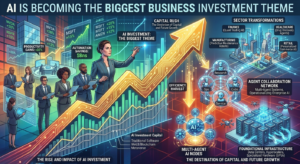
Artificial intelligence has crossed a threshold. What began as experimental technology and pilot projects has become the central organizing principle of capital allocation across venture markets, corporate balance sheets, and public-equity strategies. In 2026, AI is no longer one investment theme among many—it is the dominant one.
The Scale of the Capital Shift
The numbers leave little room for debate. Gartner forecasts worldwide AI spending will reach $2.59 trillion in 2026, a 47 percent increase from the prior year. Infrastructure—AI-optimized servers, networking, semiconductors, and related capacity—accounts for the largest share, projected at roughly $1.43 trillion.
Venture capital tells a parallel story. AI companies attracted approximately $202 billion in 2025, representing nearly half of all global startup funding. In the first quarter of 2026 alone, AI absorbed an even larger share—reports place it near 80 percent of total venture dollars in some periods—driven by mega-rounds for foundation-model developers and infrastructure providers.
Corporate deal-making has followed. Global announced deals reached about $3.2 trillion in the first half of 2026, the strongest six-month period in at least a decade, with AI-related activity a primary catalyst—including large transactions aimed at securing electricity capacity for data centers.
From Experimentation to Operational Priority
The shift is visible inside enterprises. Surveys of chief information officers show near-universal budget allocation to AI and large-language-model projects, with the majority creating entirely new AI budgets rather than simply redirecting existing IT spend. Adoption is moving from isolated pilots into production workflows. Companies are embedding generative and agentic capabilities into core systems for customer operations, software development, finance, marketing, and supply-chain processes.
This transition reflects growing confidence that AI can deliver measurable productivity gains. Estimates of generative AI’s potential annual economic contribution run into the trillions of dollars, concentrated in knowledge-work intensive functions. As a result, AI is increasingly treated as operational infrastructure—comparable to the cloud computing buildout of the previous decade—rather than discretionary innovation spending.
Where Capital Is Concentrating
Investment is not evenly distributed. Capital flows heavily toward three layers:
– Infrastructure and computer: The largest near-term destination. Demand for GPUs, accelerators, high-performance networking, and data-center power is driving both public-company capital budgets and specialized private financing.
– Foundation models and platforms: A small number of frontier labs and platform companies continue to attract outsized rounds and valuations, reflecting the belief that scale and model quality remain decisive advantages.
– Enterprise applications and agentic systems: Spending on AI software, specialized models, and orchestration platforms is accelerating as organizations seek tools that move beyond chat interfaces into multi-step, goal-directed automation. Forecasts show particularly rapid growth in generative AI models and related platforms.
Vertical applications and industry-specific solutions are also receiving selective funding, though capital has become more concentrated around companies demonstrating clear defensibility or distribution advantages.
Risks and the Reality Check
The scale of investment brings corresponding risks. Hardware and infrastructure spending currently outpaces model and platform revenues in many analyses, raising questions about the speed of monetization. Enterprise buyers are applying greater scrutiny to usage efficiency, cost control, and measurable outcomes. Supply constraints—chips, power, and skilled talent—remain binding in places. Market concentration, both in funding and in equity returns, creates vulnerability if a handful of leading companies disappoint.
Yet the direction of travel is clear. Even cautious observers note that AI-related capital expenditure is tracking above earlier elevated forecasts and is already influencing broader economic data in major economies. The comparison often drawn is to historic infrastructure cycles—railroads in the nineteenth century or the internet buildout—where early overcapacity eventually underpinned longer-term productivity gains.
Implications for Business Leaders and Investors
For corporate decision-makers, AI has moved from optional experiment to strategic necessity. Boards and executive teams are allocating dedicated budgets, redesigning workflows, and building internal capabilities or partnerships to capture value. Those who treat AI solely as a cost center risk falling behind competitors who convert it into operating leverage.
For investors, the theme spans public equities (hyperscalers, semiconductor leaders, and AI-enabled software firms), private markets (foundation models, infrastructure, and vertical applications), and adjacent real assets (power generation and data-center real estate). Selectivity matters. Returns are likely to favor companies that combine technological capability with distribution, data advantages, or clear paths to sustainable unit economics.